The FIFA World Cup Communications XI: Tournament wins and reputation own goals
By David Alexander
The 2026 FIFA World Cup has demonstrated the unrivalled communications power of global football while exposing how quickly governance failures and commercial overreach can damage trust in the tournament.
The biggest show on earth: Five World Cup communications hits and misses
The FIFA World Cup remains the biggest communications platform in sport. No other event places players, governing bodies, sponsors, politicians and host nations under the same level of sustained global scrutiny.
Every decision carries reputational consequences. A refereeing controversy can become a governance crisis, while a spontaneous supporter celebration can travel around the world before an official campaign has left the approval process.
The 2026 tournament has produced outstanding examples of personality-led communication, supporter culture and purposeful storytelling. It has also exposed inconsistencies between FIFA’s stated values and the way the organisation has handled politics, player welfare and commercial expansion.
These are five communications successes and five reputation failures from the biggest show on earth.
THE HITS
The beautiful game becomes the growing game
Amid the furore about the extortionate price of tickets during the World Cup, FIFA can legitimately lay claim to building revenues and giving more teams access to the greatest show on earth.
With 48 teams competing for the first time, viewers saw teams that have rarely or never before appeared on the biggest stage, benefiting from the expected $15bn revenue that FIFA have overseen.
There were concerns about ticket pricing leading to empty stadia, but according to FIFA and independent research, the venues were almost full to capacity despite early views of empty seats.
Assessments put FIFA’s World Cup brand value trebles to £4bn thanks to sponsorship and media rights, even if the unpopular hydration breaks gave more advertising slots. Fox paid $485m for the US English-language rights with more than half of that recouped by hydration breaks, according to industry analysts.
FIFA President Gianni Infantino said: “I think we can say that this FIFA World Cup here in particular has opened a lot of doors, a lot of opportunities, a lot of possibilities,
“We will continue to work together to really unleash this whole commercial potential that we have to make football even better, to make football even bigger, to make football even more global all over the world..”
Whether smaller nations do ultimately benefit from the increase in revenue remains to be seen, but the numbers certainly look good for Infantino as his re-election looms.
David Beckham confirmed his status as Britain’s greatest sporting export
David Beckham appeared throughout the tournament as a former player, ambassador, businessman, celebrity and commercial partner.
He attended major matches, moved comfortably between football and entertainment audiences and featured in campaigns for eleven brands. Few retired athletes can offer the same combination of recognition, credibility and cultural relevance.
Credited with transforming football in the US, both as a player and now as a club owner, he is also the first footballer to receive a star on the Hollywood Walk of Fame.
The strength of Beckham’s position is that his commercial visibility rarely feels disconnected from the game. Supporters still recognise him first as an England captain and Manchester United player, giving his brand work a foundation that many celebrity ambassadors lack.
His World Cup presence demonstrated the long-term value of managing an athlete’s reputation beyond retirement. Beckham remains football’s most reliable bridge between the pitch, sponsors, hospitality audiences and popular culture.

Smaller nations became the World Cup’s most powerful storytellers
One of the tournament's biggest communications successes came from teams that arrived without global stars or major commercial profiles. Instead, they brought authentic human stories that audiences wanted to follow.
Cape Verde became one of the World Cup's surprise success stories, with their run capturing attention far beyond results on the pitch. Central to that was goalkeeper and captain Vozinha, whose performances turned him into an overnight global figure. His Instagram following grew dramatically during the tournament, from 50,000 to 21m, as supporters connected not only with his goalkeeping but also with the story behind the man. Images of him embracing family members after matches and speaking about what representing Cape Verde meant resonated across social media far more effectively than polished promotional campaigns.
The lesson is an important one for rights holders. In an era of sophisticated content strategies, audiences still respond most strongly to authenticity. FIFA provided the stage, but it was the players and their personal stories that created the emotional connection. Sometimes the most powerful communications strategy is simply allowing genuine stories to be told.
Erling Haaland and Norway gave the tournament its most authentic celebration
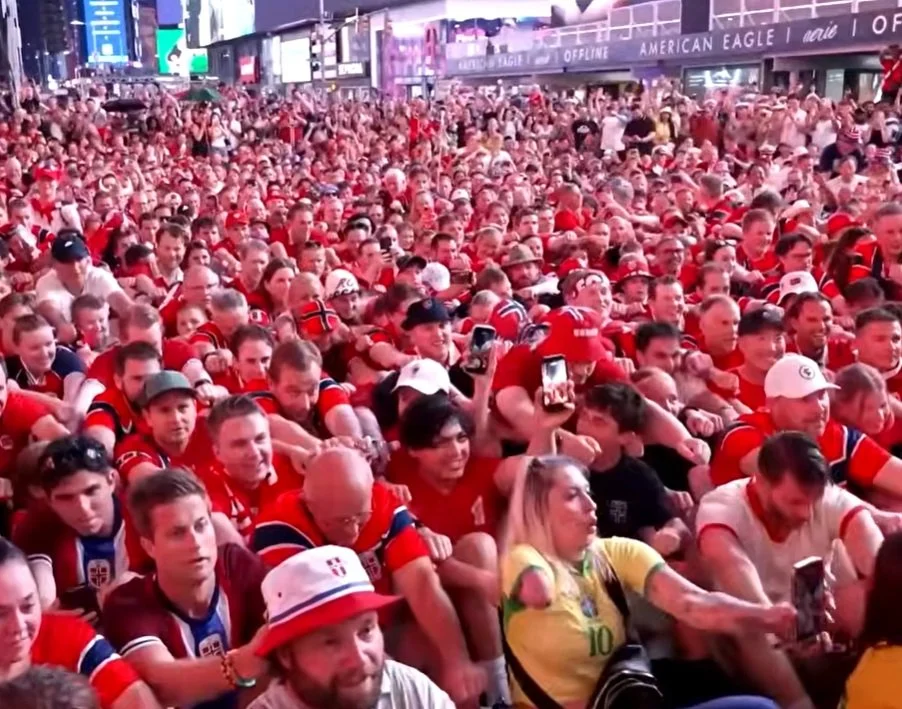
Norway’s Viking Row became one of the defining images of the World Cup, with supporters and players performing the synchronised celebration in stadiums, streets and public spaces.
Its success came from authenticity. The celebration was not created by a sponsor or designed around a campaign hashtag. It belonged to the supporters and reflected a genuine connection between the team and those who had travelled to follow them.
Haaland understood his role within that story, joining the celebrations without attempting to dominate them, allowing Norway’s collective identity to take precedence over his individual profile. Other players struck a drum after matches, further cementing the bond between squad and fans.
The scenes in Times Square showed how quickly a strong piece of supporter culture can become globally recognisable. Norway didn’t need a polished campaign to communicate who they were.
Supporters remained the tournament’s best content creators
The strongest images of the World Cup were repeatedly created by supporters rather than organisers.
Street celebrations, travelling fan groups, national costumes, songs and spontaneous interactions gave the tournament a character that official content could amplify but not reproduce.
Successful sports communication increasingly depends on recognising when an organisation should lead and when it should step back.
FIFA and national associations benefited when they distributed supporter-generated moments without over-branding them or forcing them into campaign language.
Content creators gave fans behind-the-scenes access that brought the tournament to life beyond matches.
Tik Tok content, for instance, we visited more than 413m times while Threads reported 1.5 billion impressions on tournament-tagged posts and 80m posts mentioning the World Cup were created on Facebook.
The tournament also showed that fan culture travels effectively across short-form video platforms. A celebration in one host city could become familiar to viewers around the world within hours.
Supporters didn’t just attend the World Cup, they became its most credible communications network.
THE MISSES
The Balogun decision turned a red card into a governance crisis
FIFA’s decision to suspend the implementation of Folarin Balogun’s automatic one-match ban created a problem far greater than the original refereeing incident.
US President Donald Trump publicly confirmed that he had contacted FIFA president Gianni Infantino about the case. The subsequent decision allowed a perception to develop that political access could influence the application of tournament rules.
FIFA insisted that its disciplinary bodies were independent, but its explanation came after the central narrative had already formed and with reports that only one person made the decision to let Balogun play.
The communications failure was allowing uncertainty over who made the decision, why an automatic sanction was treated differently and what role Trump’s intervention played.
UEFA’s unusually forceful criticism then ensured that the dispute became an institutional crisis rather than a short-lived disciplinary story.
FIFA left Omar Artan without visible support
Somali referee Omar Artan was selected to officiate at the World Cup but was refused entry to the United States despite reportedly holding valid travel documentation.
Artan returned home without taking part in a tournament that should have represented a career-defining achievement. FIFA did not provide the level of visible advocacy expected for an official appointed to its flagship competition.
UEFA subsequently appointed him to the Super Cup, allowing European football’s governing body to make the more powerful public statement.
The episode created an impression that FIFA had failed in its duty of care to one of its own match officials.
A governing body cannot control every border decision. It can, however, communicate clearly, support the individual publicly and demonstrate that it is challenging an unacceptable outcome.
Hydration breaks looked like commercial breaks
FIFA introduced a three-minute hydration break in each half of every match, regardless of temperature or playing conditions.
The policy was presented as a player welfare measure, but its universal application weakened that explanation. In cooler conditions and climate-controlled stadiums, the interruptions appeared unnecessary from a sporting perspective.
US broadcasters used the breaks as advertising opportunities, reinforcing the perception that football had been divided into four quarters to create additional commercial inventory.
Player welfare requires flexibility based on evidence, conditions and medical advice. A fixed break in every match looked designed around the broadcast schedule rather than individual need.
Once that perception took hold, FIFA’s welfare messaging became difficult to sustain. The pauses communicated commercial adaptation more loudly than player protection and the attending crowds usually let everyone know what they thought.
The final show risked making football the supporting act
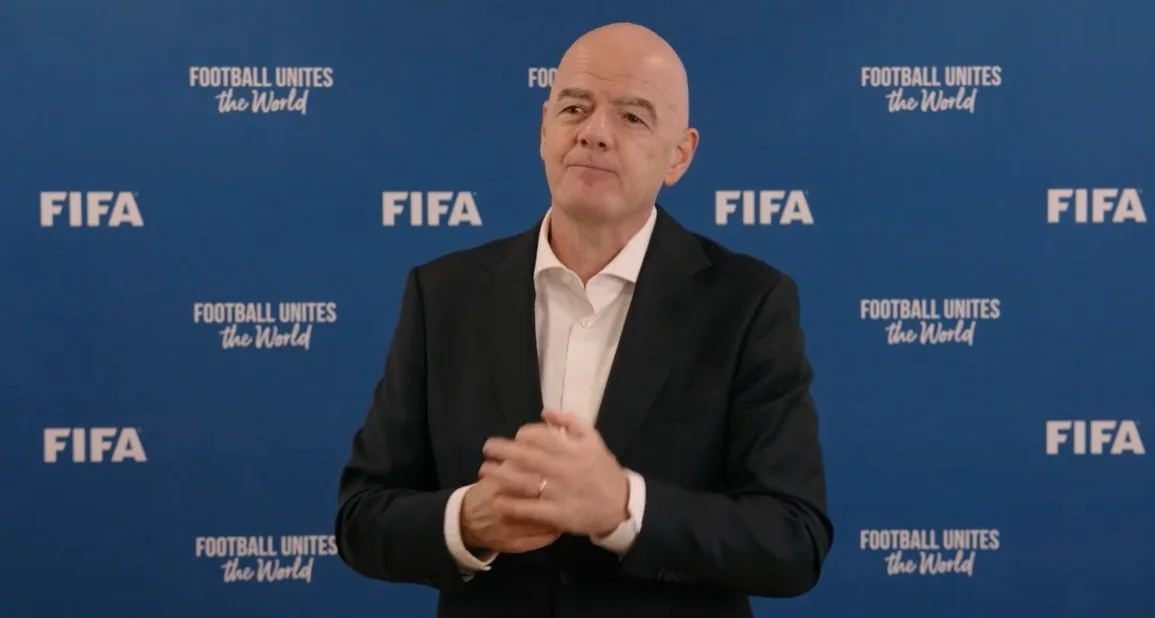
FIFA’s decision to introduce an extended half-time show during the World Cup final reflects its ambition to create a global entertainment spectacle.
The problem was not the presence of music or prominent performers, but the possibility that the 30-minute interval could change the sporting product to accommodate the show.
Extending half-time risks affecting players physically while telling traditional football audiences that the match must adapt to the expectations of broadcasters and the US entertainment market.
The World Cup final doesn’t struggle for attention – it’s already one of the most valuable and watched events in global entertainment.
It all felt very schmaltzy and Superbowl-centric in style, which hasn’t translated well for other sports during showcase events either.
The treatment of Iran contradicted FIFA’s global message
FIFA repeatedly promotes the World Cup as an event that unites countries and treats every participant as part of one global football community.
Iran’s experience challenged that message. The team faced travel restrictions, shortened preparation periods and instructions to leave locations quickly after matches, while players and officials publicly complained about their treatment.
Political and security issues surrounding Iran were complex, but that made clear communication and visible support more important.
FIFA appeared unable or unwilling to protect the team from conditions that affected preparation and recovery. Comments by US political figures celebrating Iran’s elimination added to the sense that the host environment was not neutral.
The gap between FIFA’s language and the team’s experience made its claim to represent “the world’s game” less convincing.
La Albiceleste
What is likely to be Lionel Messi’s final World Cup ended in disappointment in New Jersey, with Spain coming our deserved victors.
The AFA, the Argentinian Football Association, and the national government both leaned into the controversy surrounding the team, ensuring that they will forever be associated with indiscipline and provocation.
There were suggestions that Argentina were treated favourably, with instances of fouls going unpunished and creating the moniker ‘VARgentina.’ FIFA’s inconsistent officiating and limited public explanations created an information vacuum in which accusations of preferential treatment could grow.
AFA did little to challenge that perception. Rather than projecting discipline and humility, Argentina repeatedly allowed incidents around the team to reinforce the idea that different rules applied to the holders.
The Malvinas banner displayed after the victory over England was another avoidable communications failure, introducing a sensitive political dispute into a sporting celebration.
Argentine President Javier Milei remained defiant: “The Malvinas are Argentine. What the players did is understandable; emotion got the better of them.
“They did it, and that will probably lead to a discussion of an economic sanction. It is perfectly valid and legitimate for the players to want to express themselves and do so.”
FIFA would have been expected to take disciplinary action before the final but the incident was sidelined by the governing body.
While Enzo Fernandez’s dismissal in the final set the tone for the game, Argentine players fighting their opponents after the final whistle has prompted FIFA to launch a disciplinary investigation. Whether it will undo some of the damage those shocking scenes provoked remains to be seen.
Blurring the lines
The defining communications lesson from the tournament is that reputation is built through consistency.
Football’s emotional reach remains extraordinary, but governing bodies cannot rely on the spectacle to obscure contradictions between their messages, decisions and conduct.
Want to keep the debate going? Join the CIPR Sports Network WhatsApp group:https://chat.whatsapp.com/BIjxsUQRQOw1BUwtfuqUac?mode=gi_t