

Beyond the Pitch: What the World Cup revealed about engaging younger sports fans
By Rebecca Roberts, CIPR Sports Committee Member
When people think back to the FIFA World Cup they’ll remember the matches, the memes and the unlikely stars of the tournament. From a communications perspective though, something significant too.
Across YouTube, TikTok, WhatsApp and in the comment sections, the tournament revealed what many of us have been seeing for some time. Younger audiences are experiencing and engaging with sport differently.
Not as a single live event, but as part of a much broader entertainment ecosystem.
This isn’t just shifts in internet culture though, it was built into the media strategy and commercial partnerships around the World Cup. And we’ll undoubtedly see more of across the sports landscape.
The question is: what can this tell us about engaging younger sports fans and what can we build into our own sports communications strategies to engage all age groups?
The Game’s Gone
Well, not quite. But for decades, sport has had a relatively straightforward model. Fans watched performances, they consumed post-match/race analysis, read interviews, and followed media coverage about team, athlete and/or club developments.
Today, the game is often just one chapter in a much larger entertainment ecosystem. Fans follow WhatsApp Channels, TikTok feeds and fan edits, while the stories surrounding the game can become as significant as the results themselves.
Research from Bango found that almost half of 18-24s (47%) and over half of 25-34s (51%) say highlights are replacing live games for them. More than half regularly follow matches through clips, updates and social media rather than watching the full event live.
The scheduling of this World Cup - with matches in the middle of the night in the UK - arguably accelerated that behaviour, with many fans relying on highlights rather than watching matches live. The BBC have been building their highlights offering on its app and on iPlayer for the Premier League over the last season – so it’s something we’re getting used to (at all ages!).
In short, the match itself is no longer the entire product. The game has become one part of a broader entertainment ecosystem that spans creators, clips, communities and culture.
Why creators matter
WIRED recently compared influencer iShowSpeed to Gen Z’s ESPN this World Cup. Having amassed an incredibly engaged fandom of his own (55 million subscribers and counting) he started out in the traditional streamer model of playing FIFA from his bedroom during the pandemic before branching out with his always-on travel content, touring the world and the US, with sport being a large part of his output. He created content from host cities throughout the World Cup and met celebrities and players as he went.
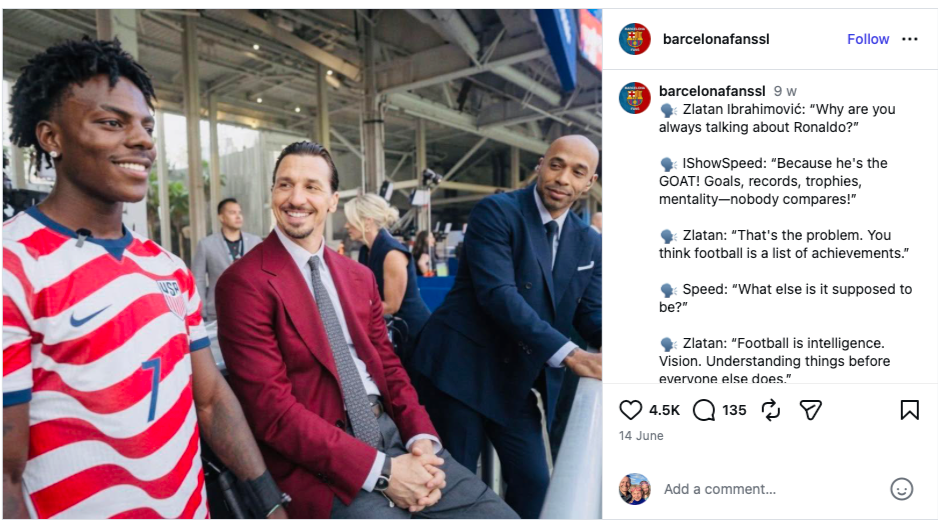
IShowSpeed's appearance with Zlatan Ibrahimovic and Thierry Henry promoted lots of online debate. Photo: Instagram.
For many younger audiences, creators are no longer simply commenting on sport. They are becoming the lens through which sport is experienced.
We’re also seeing this play out for older fans too. The rise in podcasts becoming fully fledged media outputs, producing not just audio and social clips, but full-length YouTube outputs has led to a gear shift since the last World Cup.
Gary Lineker’s podcast company Goalhanger did a deal with Netflix for 40 episodes of the Rest is Football during the World Cup, building on its ‘after-hours’ feel and engaged audience since its launch at the Euros 2024. Not an official rights holder, the podcast was still able to offer that analysis, tournament drama and conversational content that along with the Overlap and Stick to Football reached audiences in their millions. Netflix has now extended the deal to 2028 to cover the Premier League and the Champions League and up to the 2028 Euros.
We’re seeing this play out across other sports too. Formula 1’s transformation over recent years has been well documented, with Netflix’s Drive to Survive helping to introduce entirely new audiences to the sport through personalities, rivalries and stories before many had even watched a race. For many younger fans, the narrative became the entry point, with the racing following afterwards.
Ditto running. The growth of the marathon, HYROX and endurance creators has seen thousands of people following training journeys, race-day content and behind-the-scenes experiences, often from people they feel they know rather than official event organisers. The community built around these creators has become participatory in and around the race/competition day itself.
For women’s sport we can see this approach also being embraced, although perhaps this is more indicative of a commercial need in comparison to their male counterparts. However, the direct connection athletes can have has attracted fans who are invested not just in results, but in people.
Partnership shifts
While the ongoing discussion about partnerships and investments with FIFA continues, what this World Cup showed was a recognition of the entertainment world and integrating influencers and platforms into the tournament experience.
For the first time, FIFA’s official media partners had the option of live streaming the first 10 minutes of every match on their YouTube Channel (YouTube being a preferred platform partner).
The YouTube FIFA Creator Cup launched for the first time too, live streaming from New York earlier in July to a live audience of over 10 million. It brought YouTube creators, elite athletes and celebrities together for a match, for entertainment.
The partnership also saw a creator lineup from YouTube who have been attending matches to “capture the sport, culture, and community through a unique lens for their combined 350+ million subscribers”, all badged as bringing the tournament to a broader, more diverse audience. The Sidemen were UK’s contribution to the creator line up in case you’re wondering – the BBC also worked with the Sidemen for watch-along parties.
Culture in the comments and around the game
Fandoms have always had a direction of their own and one that communications teams have to balance carefully with their club or organising body’s values and priorities. What’s fascinating now is that they’re more open and accessible than ever.
It’s in the comment sections, in fan communities, creator comments and reaction content. Your social listening strategy could provide you with the blueprint for what fan groups are feeling and how you can align to, manage or support when needed.
The lore around Tim Payne gathering millions of fans overnight, the journey of Vozihna, Cape Verde’s goalkeeper, and generally Haaland (‘nice’) were all subplots to the tournament but ones that online audiences are seeing at pace within the short news cycles that social media present.
Brands will be leaning into these cycles just as much as the matches as they determine which stories further extend their reach into youth audiences engaged with the World Cup, as well as those just chronically online and aware of them. In many cases, the comments section has become the modern focus group.
What does this mean for sports communicators?
Younger sports fans are experiencing major tournaments in a different way to previous generations and their experiences and expectations are shifting as a result. The challenge for communicators is providing these younger fandoms with the right content, access and participation that they have become accustomed to.
With the traditional model for fan content evolving at pace, sports communicators need to listen and engage with young fans more than ever if they want to future proof their communications strategies.
The organisations that succeed will be those that understand sport as part of a wider entertainment, creator and community ecosystem and build communications strategies that reflect that reality.